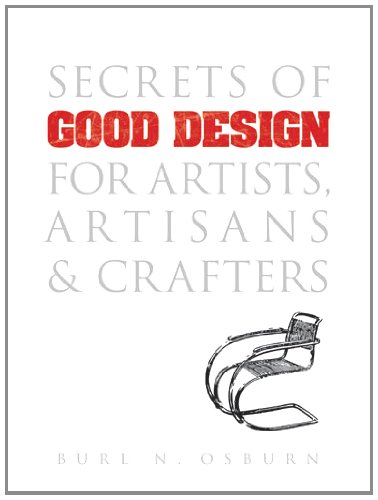
Here's an interesting book I picked up the other day: Secrets of Good Design for Artists, Artisans, and Crafters by Burl N. Osburn. It's one of those Dover re-prints of historical books (which I love, of course) This one in particular was originally published with the title Constructive Design in 1948. It's basically an instructional manual that covers design concepts and principles in a variety of media. What really makes this book unique is the abundance of useful illustrations and the tidy hand-written text. While this book is decidedly educational in purpose, it is more of a primer than a textbook. It is very short and to the point, focusing on fundamental guidelines for creating and appreciating good design. It even contains a section of practice exercises. While some of the objects and processes described in the book are now obsolete, most of the information in this book is still useful
Showing posts with label books. Show all posts
Friday, June 21, 2013
Books: Secrets of Good Design for Artists, Artisans, and Crafters
Here's an interesting book I picked up the other day: Secrets of Good Design for Artists, Artisans, and Crafters by Burl N. Osburn. It's one of those Dover re-prints of historical books (which I love, of course) This one in particular was originally published with the title Constructive Design in 1948. It's basically an instructional manual that covers design concepts and principles in a variety of media. What really makes this book unique is the abundance of useful illustrations and the tidy hand-written text. While this book is decidedly educational in purpose, it is more of a primer than a textbook. It is very short and to the point, focusing on fundamental guidelines for creating and appreciating good design. It even contains a section of practice exercises. While some of the objects and processes described in the book are now obsolete, most of the information in this book is still useful
Monday, January 7, 2013
A Jewelry Geek's Reading List: Victorian Jewelry Design by Charlotte Gere
Anyway, I'm continuing my jewelry geek educaton by reading "Victorian Jewelry Design" by Charlotte Gere. For those of us interested in the history of jewelry design the Victorian era is an especially interesting period, when jewelry designers were inspired by a wide range of historical and archeological sources, and increases in mass-production significantly changed the way jewelry was made and sold. Published in 1972, this book is text-heavy, with a decent number of illustrations in black and white. Definitely for serious jewelry geeks only.
Wednesday, June 27, 2012
Book Review: Wire Jewelry Masterclass

I just picked up Wire Jewelry Masterclass by Abby Hook. For those of you who are interested in learning wirework techniques I can't recommend this book highly enough. There are tons of wire jewelry making books out there but this one is by far the most comprehensive and instructive book I've seen. The book is divided into easy, intermediate, and advanced projects and each project features many step-by-step images. The techniques featured in the projects can be readily adapted into your own original designs. I've been trying to learn more wirework techniques myself and I found this book to be really helpful and inspirational as well.
Monday, November 8, 2010
Book Review: Metal Clay The Complete Guide
Since I just started dabbling in metal clay, I wanted to share the book I have been using as my beginner's textbook. It's called Metal Clay The Complete Guide: Innovative Techniques to Inspire Any Artist, written by metal clay artist Jackie Truty. This is a great book for a beginner, because it provides you will all the information you need to get started, but it also contains plenty of information on more advanced techniques to try as your skills improve. I really appreciate craft books that are written as a reference guide and not just a series of projects, and while this book does contain four step by step projects (two easy and two very challenging) the majority of the book consists of explanations of techniques, troubleshooting for common problems, and tips on combining metal clay with other materials. I also like that the book is spiral bound, so you can keep it open hands-free while you work. My only criticism of the book is that it's almost a little too concise, and I occasionally felt that I could use a little more explanation, but once I went over it all a second time, it all made sense. Overall, I would definitely recommend this book for anyone using metal clay.
Monday, July 27, 2009
Silver Threads: Making Wire Filigree Jewelry

I guess I've been on a bit of a book buying kick lately. I just got "Silver Threads: Making Wire Filigree Jewelry" by Jeanne Rhodes Moen. I've been doing some soldered wirework lately, but I have been pretty much making it up as I go along, so I wanted to get a book to learn some good techniques for making designs with wire scrolls. This book includes examples of filigree work (and some things that look like filigree) from around the world, as well as numerous examples of the author's own work. It includes a sections on basic metalworking techniques, and all the basic tools and materials needed for filigree work. It then goes on to explain how to form each of the classic wire units that make up filigree pieces. The book contains a sequence of step-by-step filigree projects from simple to advanced, with ideas for variations. Personally, I hardly ever work through the step by step projects in books. I prefer to learn the techniques and then experiment with my own project ideas, but the projects do give some wonderful examples of how different units can be combined to form a wide variety of designs. The projects in this book are primary done in filigree wire (round wire twisted together and then flattened) but I think the same techniques could be applied to any kind of wire that can be soldered. I would definitely recommend this book to anybody who is interested in in making soldered wirework.
Saturday, July 18, 2009
500 Enameled Objects
I just got this book in the mail and I am so excited about it! I already have several books in this series (1000 rings, 500 brooches, etc) and I enjoy them because they feature such a wide variety of pieces, and the focus is really on letting the work speak for itself. So obviously I was really excited when I saw a book featuring my favorite medium. 500 Enameled objects features all kinds of enamel work from sculptural objects to vessels and jewelry. I'm really enjoying seeing how versatile enamel can be. I would definitely recommend this book to anybody who works in enamel or anybody who is interested in it.
Sunday, May 25, 2008
On Divers Arts
Here's a book that would be an interesting read for artist and craftspeople, especially those who work in glass or metal:
"On Divers Arts" is a book by a medieval monk and artist named Theophilus. It describes the technical processes used for painting, working in glass, and metalworking. I might be a bit nerdy, but to me it is fascinating to read about how things were done so long ago, when everything needed to be made from scratch, and there were no such things as electric kilns, power tools, or even torches. Most of it seems like pretty credible technical information, but there are a few questionable parts. Take, for instance, this passage from a chapter on hardening tools:
"Take a three year old goat and tie it up indoors for three days without food, on the fourth day give it fern to eat and nothing else. When it has eaten this for two days, on the following night shut it up in a very large jar perforated at the bottom, and under the holes put another vessel, intact, in which you can collect its urine. When enough of this has been collected in this way during two or three nights, let the goat out and harden your tools in this urine.
Tools are also made harder by hardening them in the urine of a small red-headed boy than by doing so in plain water."
Hmmm...
First of all, this was clearly written long before people were concerned with animal rights. Second, where would you get a jar big enough to fit a goat inside?
It would probably be easier to get the small red-headed boy pee instead, but people might wonder what you were up to. On second thought, they would probably be just as curious about the goat in a jar.
Maybe you should just harden your tools in water and deal with them not being as hard as they could be.
"On Divers Arts" is a book by a medieval monk and artist named Theophilus. It describes the technical processes used for painting, working in glass, and metalworking. I might be a bit nerdy, but to me it is fascinating to read about how things were done so long ago, when everything needed to be made from scratch, and there were no such things as electric kilns, power tools, or even torches. Most of it seems like pretty credible technical information, but there are a few questionable parts. Take, for instance, this passage from a chapter on hardening tools:
"Take a three year old goat and tie it up indoors for three days without food, on the fourth day give it fern to eat and nothing else. When it has eaten this for two days, on the following night shut it up in a very large jar perforated at the bottom, and under the holes put another vessel, intact, in which you can collect its urine. When enough of this has been collected in this way during two or three nights, let the goat out and harden your tools in this urine.
Tools are also made harder by hardening them in the urine of a small red-headed boy than by doing so in plain water."
Hmmm...
First of all, this was clearly written long before people were concerned with animal rights. Second, where would you get a jar big enough to fit a goat inside?
It would probably be easier to get the small red-headed boy pee instead, but people might wonder what you were up to. On second thought, they would probably be just as curious about the goat in a jar.
Maybe you should just harden your tools in water and deal with them not being as hard as they could be.
Subscribe to:
Posts (Atom)


